Street renaming policy during Ukraine’s decommunization
Grey BeesStreet renaming policy during Ukraine’s decommunization is presented not only as a public effort to replace Soviet names but as a conflict over who gets to name a place, and who can make that decision meaningful in a nearly emptied village. For Sergey Sergeyich, the argument moves from a conversation with Petro to an overnight act of practical, unofficial authorship: he chooses to live on Shevchenko Street, then swaps its signs with those of Lenin Street. The gesture is playful, stubborn, and provisional, set against political divisions and the physical decay of the village.
The policy as a political argument
Petro describes the renaming of towns and streets as one more burden in a country with more urgent worries. He lists the resistance around the process: some people refuse to take down street signs, while others want the flag reversed. His remarks make renaming appear both administratively laborious and politically contested. He even proposes, uncertainly, that the country itself might be called the Ukrainian People’s Republic.
Sergeyich rejects that suggestion because he distrusts the word “People’s,” imagining that it would place fools and criminals in power, as he believes has happened in the “Deepee-arias.” His response is not a defense of the old names so much as a suspicion of political labels and the power they claim to represent. The exchange leaves him tired of national-scale arguments, but it also gives the abstract dispute a precise local address: he and Petro are speaking on Lenin Street.
In a separate conversation, Sergeyich asks what names are replacing those of Marx and Lenin. Petro says they are being replaced by names associated with Bandera or with writers. Sergeyich says he would prefer a writer. When Petro explains that Lenin Street will be renamed after the war, Sergeyich asks whether he could choose its new name himself. Petro answers that residents must agree and take their proposal to the local council. The process is therefore represented as collective and official: one resident may propose a name, but the street’s inhabitants and local government must authorize it. Sergeyich doubts that agreement will come quickly.
An unofficial act of naming
Rather than wait for the postwar process, Sergeyich acts at night. He has decided how to occupy himself until dawn, reasoning that the wartime circumstances make daylight work unsafe because someone might observe the horizon through binoculars, a periscope, or an optical sight. He dresses warmly, gathers tools from the garage, and carries them in a backpack that belonged to a dead soldier. The renaming question becomes an operation conducted under the conditions of the war, not a calm civic procedure.
At the point where the dirt road enters the village, Sergeyich tears down the blue-and-white sign marked LENIN STREET with a claw hammer and puts it in his backpack. He then works along the street, checking fences and houses for further signs. One sign, nailed directly to a house with ten-millimetre nails, takes him about five minutes to pry loose and bends slightly in the process. The painstaking removal makes the street name a physical object: it has to be found, levered away, carried, and ultimately put back somewhere else.
Sergeyich next goes to Pashka’s street and removes six SHEVCHENKO signs. He finds fewer of them than Lenin signs, despite the streets having almost the same number of houses. He explains the imbalance to himself through the past: Lenin had mattered more in Soviet times, his name known around the world, while Shevchenko was known only locally. He then dismisses the comparison. In his judgment, poets are harmless in a way politicians are not, and he resolves to live on Shevchenko Street.
Reversing the signs
Sergeyich first nails a SHEVCHENKO sign to his own fence, to the left of his gate. He replaces the sign at the start of the street and puts another at the last house on the right, nearest the church. The choice is personal, but he makes it legible at both ends of the street: his address and the route’s public markers now express the name he prefers.
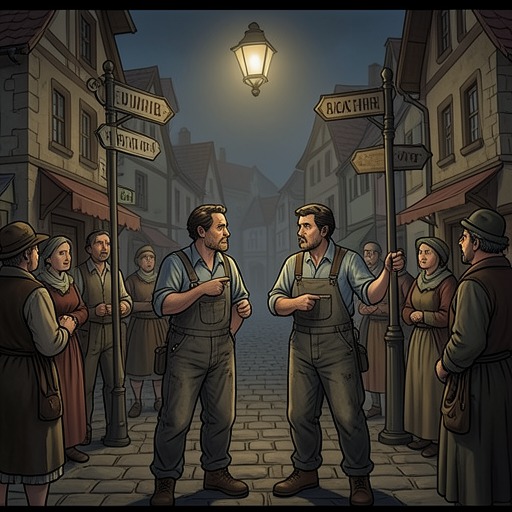
At half past four, with hours still remaining before dawn, he returns to the yard for his hammer, nails, and the LENIN signs. He then goes back to what had been Shevchenko Street and puts Lenin signs on either side of Pashka’s gate before distributing the remaining ten along the street, including one at each end. The exchange is not a formal renaming approved by residents or the council. It is Sergeyich’s deliberate redistribution of the signs, carried out without asking Pashka and without even considering that the hammering might wake him.
The locations give the gesture an unsettled, comic edge. Sergeyich installs the name he favors on his own street, while Lenin’s name is placed on Pashka’s. At the end of Pashka’s street stand the dilapidated cowsheds of the closed Iona Yakir collective farm and other buildings stripped of slate, window frames, and many of their bricks. The old political name ends amid the visible remains of a failed and abandoned order; the new name is chosen not through a triumphant public ceremony but through a solitary night’s labor.
Wartime names and contested belonging
The novel places this small act beside the larger mechanisms through which names and borders classify people. During a later checkpoint inspection, a soldier checks Sergeyich’s passport and asks by radio whether Little Starhorodivka is in the Donetsk People’s Republic. Elsewhere, at the Russian border, Sergeyich sees a sign naming the Dzhankoy checkpoint and recalls a warning painted on a transformer box that calls the Russian forces occupiers. These episodes do not establish the outcome of the village’s street-renaming process, but they show how official labels, territorial claims, and administrative checks shape movement and belonging throughout the story.
Against those stakes, Sergeyich’s exchange of signs is deliberately limited. It neither settles a national dispute nor secures agreement among the people who live on the streets. Its significance lies in the contrast between policy’s demand for consensus and his own nocturnal improvisation. He takes the proposed future of a street name into his hands, but the result remains an act within a village whose signs can be moved more easily than its inhabitants can escape war, surveillance, and abandonment.